One integrated path, several ways to serve.
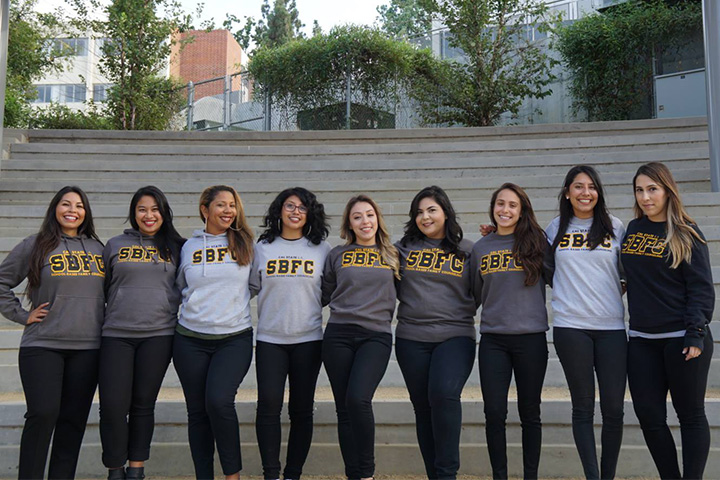
The School-Based Family Counseling (SBFC) approach connects the two places that shape so much of a child’s life: home and school. When a child struggles, counselors look at the relationships and experiences around them, engage parents and caregivers as partners, and bring family therapy and school counseling together to support both wellbeing and school success.
All students complete the M.S. in Counseling along with the PPS Credential in School Counseling and the Advanced Authorization in Child Welfare and Attendance (CWA). There is no MFT-only option.
Virtual Information Session
Learn more about the program, clinical training, application process, and career paths. Times are Pacific Standard Time.
Thursday, November 19, 2026
12 - 2 p.m. - Zoom
Program Overview
DEGREE
M.S. in Counseling: SBFC
PREPARATION
MFT + PPS School Counseling + CWA
FORMAT
In person, full time
SCHEDULE
Primarily late afternoon and evening
LENGTH
About 2½–3 years
GRE
Not required or accepted
MFT-ONLY OPTION
Not available
ONLINE OPTION
Not available
The program emphasizes multicultural conjoint family therapy, social justice, supervised clinical work, and school-based counseling. Students learn to advocate for children and families and to increase family involvement in a child’s education when school or family challenges affect learning. Graduates work in schools, mental health agencies, community organizations, and clinical settings; some have gone on to earn doctoral degrees.
Marriage and Family Therapy
Coursework designed to satisfy academic requirements toward California MFT licensure. Licensure also requires post-degree steps set by the state. California MFT license requirements
School Counseling
Preparation for the Pupil Personnel Services Credential in School Counseling. California PPS School Counseling requirements
Child Welfare & Attendance
Preparation for the Advanced Authorization in Child Welfare and Attendance. <
How to Apply
Opens: October 1, 2026
Deadline: January 15, 2027
Complete Cal State Apply and upload all required application materials, including unofficial transcripts from every degree institution, by January 15. Incomplete applications are not reviewed. Official transcript processing may qualify for the courtesy extension described below.
In Cal State Apply, look under Graduate Degree Programs → Cal State Los Angeles → Counseling → School-Based Family Counseling – Marriage and Family Therapy and School Counseling.
Application checklist
- Two-page resume
- Personal statement, no more than three pages
- Unofficial transcripts from all degree institutions
- Two recommendations: an academic reference is preferred, plus a professional reference; a second professional reference is accepted if you completed your degree some time ago
- Official transcripts submitted to the University
GPA and interview consideration
Minimum to apply: A 2.75 GPA in the last 60 semester units (or 90 quarter units).
Required for interview consideration: A 3.0 GPA in the last 60 semester units (or 90 quarter units) and direct experience listening to and supporting people experiencing mental health challenges in a mental health setting. Meeting these requirements does not guarantee an interview; selection varies with each applicant pool.
1 · Submit the application
Complete the program application and upload the required materials.
2 · Send transcripts
Submit all unofficial transcripts from degree institutions by January 15. Also request official transcripts for submission to the University by January 15. If official transcript processing is delayed, the courtesy extension runs through February 6, 2027; it does not extend the unofficial transcript deadline.
3 · Interview if invited
Selected applicants complete an approximately 20–30 minute individual interview with at least two faculty members.
Application Details
The two-page resume should cover education, paid and volunteer work, and experience that shows your potential as a counselor.
The personal statement is limited to three pages, double-spaced, with one-inch margins and 12-point Times New Roman. Use specific examples to explain your career goals and inspirations, why this degree matters to those goals, experiences working with others (including strengths and growth areas), and how your approach to teaching, learning, counseling, or leadership aligns with the College of Education mission and core values.
Upload legible, correctly oriented unofficial transcripts from every institution where you earned a degree by January 15. Use one file per institution with pages in order.
An academic recommendation from a former professor who can discuss your preparation is preferred. If you completed your degree some time ago, a professional recommendation may take its place. The other recommendation should be from someone who supervised you and can discuss your potential as a counselor. Follow the University's document submission instructions for official transcripts.
The program plans three cohorts of approximately 16 students. Admission is competitive; historically, more than 400 applicants have sought approximately 48 places. For interview consideration, applicants need direct experience in a mental health setting that involves listening to and supporting people experiencing mental health challenges. Examples may include mental health agencies, crisis hotlines, and domestic violence programs when the role includes direct conversations with people seeking support.
The minimum GPA to apply is 2.75 in the last 60 semester units (or 90 quarter units). To be considered for an interview, applicants need at least a 3.0 GPA in those last 60 semester units (or 90 quarter units) and the direct mental health experience described above. A cumulative GPA below 3.0 does not prevent interview consideration if the GPA in the last 60 semester units (or 90 quarter units) is at least 3.0. Meeting the criteria does not guarantee an invitation. Interviews consider knowledge of MFT and school counseling, interpersonal skills, and self-awareness. GRE scores are neither required nor accepted.
No undergraduate major is required. The single prerequisite is Counseling or Psychological Theories, with a C or better. It may be completed after applying but before entering in the fall. A Psychology degree satisfies this prerequisite. Students without an equivalent course may take COUN 4500 during the ten-week summer term before entry.
An equivalent course should substantially cover major theories, such as psychoanalytic, behavioral, Gestalt, person-centered, and cognitive approaches. Abnormal Psychology does not satisfy this requirement; Introductory Psychology generally does not, while Theories of Personality may. Email a syllabus to Dr. Michael Carter for equivalency review.
There are no other SBFC courses to complete before entering. After admission, up to 18 semester units of eligible graduate work from another institution may be considered for transfer, subject to faculty advisor and University approval. The integrated curriculum makes transfer difficult in some cases.
Tuition & Scholarship Opportunities
These are planning estimates using published 2026 fees for a sample California resident path. Actual 2027 and later costs, course loads, and fieldwork timing may differ.
| Example enrollment | Estimated tuition & fees |
|---|---|
| Four full-time semesters × $4,821.04 | $19,284.16 |
| One six-unit summer term (2026 rate) | $2,390.00 |
| Two part-time semesters × $3,027.04 | $6,054.08 |
| Illustrative total | $27,728.24 |
The fall semester amounts are published Fall 2026 graduate tuition and mandatory fees. The summer amount is the published Summer 2026 graduate six-unit total. This example uses the University’s published 2026 fees; actual charges may change with enrollment, fieldwork timing, and future rates. Check current student fees
Up to $20,000 / year
Ballmer Group grant funding expands access to clinical preparation for future counselors serving children, youth, and families in Los Angeles County. Eligible SBFC students may apply for up to $20,000 per year during the three-year program, along with expanded cohort-based learning and applied training experiences. Cal State LA intends the scholarship to cover normal tuition and fees after other eligible aid is applied. Actual awards and out-of-pocket costs vary.
How scholarship funding works
Complete the FAFSA and a supplemental scholarship application. Funding uses a last-dollar-in approach after other eligible aid. The University has not posted the SBFC scholarship application deadline on its program page; use that page for updates.
Service expectation
Recipients are expected to work for at least three years after graduation in public or nonprofit roles serving children, youth, and families in under-resourced communities within Los Angeles County.
Financial aid & Ballmer questions
Ask Cal State LA’s Center for Student Financial Aid & Scholarships about eligibility. For questions specifically about the SBFC Ballmer Grant, contact the coordinator, Dr. Nicole Garcia.
Some students defer the summer courses until after their second year. This may delay when they can begin fieldwork and could extend the time needed to graduate; discuss the sequence with a program advisor before planning around a different summer term.
Nonresidents of California, including students on F or J visas, pay an additional per-unit tuition charge. Fall 2026 lists $471 per unit. At 15 units, that adds $7,065 to the $4,821.04 full-time graduate semester charge, or approximately $11,886.04 for one semester and $23,772.08 for two. For a six-unit summer planning example, $471 × 6 adds $2,826; actual summer rates and charges can differ by year.
A continuing student initially classified as a nonresident may apply for reclassification for a later term if University requirements are met; living in California for a year alone does not guarantee eligibility. The University determines residency for tuition purposes. Review the residency and reclassification requirements and current fees before making a financial plan.
Let's Connect
We're excited that you're interested in our program!
PROGRAM DIRECTORS
For SBFC program questions, reach out to either of us:
Emily J. Hernandez, Ed.D., LMFT
SBFC Program Coordinator
Michael J. Carter, Ph.D., LMFT
SBFC Clinic Director