Master of Science Degree in Physics
Our department offers a Master of Science (M.S.) Degree in Physics for students interested in employment in industry, government, community college teaching, and/or doctorate (Ph.D.) programs in physics, astronomy, and related fields. We have both a Research Option and a Course Option depending on your desired path. The culmination of the Research Option is a research thesis and an oral thesis defense. The Course Option culminates in a comprehensive exam. Both options require the completion of core graduate courses, about three to four courses per semester, and the program is typically completed in two years.
Applications for graduate admission starting Spring 2027 are available online from July 1, 2026, until October 31, 2026 (August 31, 2026, is the deadline for international students who will require a F1 visa or I-20 to study in the U.S.); the Spring 2027 semester begins January 25, 2027.
- The minimum requirements for graduate admission into our Master's Degree program are a Bachelor's Degree (any major), and a cumulative undergraduate grade point average (GPA) of 2.50 or greater.
- Applicants with Bachelor Degrees in disciplines other than physics or astronomy are encouraged to apply; advisement will be provided for completing prerequisite coursework.
- The main website for the graduate application process at Cal State LA is: https://www.calstatela.edu/admissions/graduate-admission
- The direct link to start the online application is: https://www.calstate.edu/apply; select "Los Angeles" from among the 23 different Cal State campus locations.
- The Cal State Apply application fee is $70.
The Structure of the Master of Science Degree Program
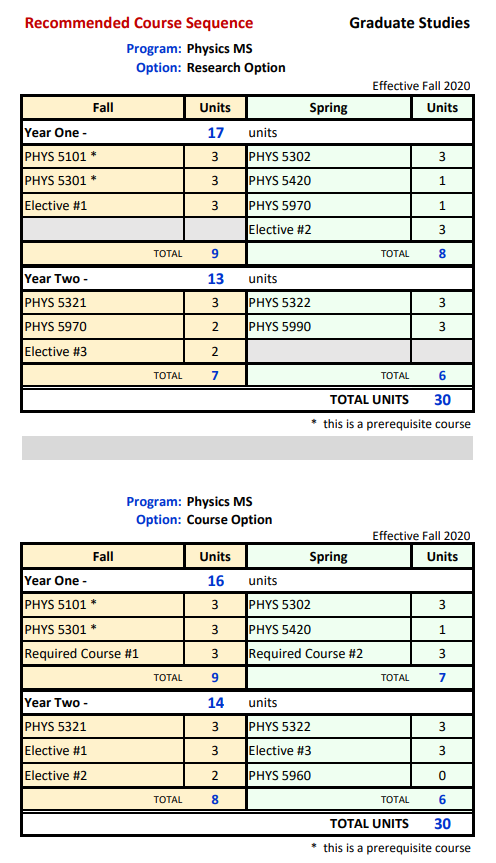
The M.S. program in Physics requires that you complete 30 credit units. There are six required core courses that every student must pass: (numbers in brackets indicate the amount of credit units earned)
- PHYS 5101 Mathematical Methods in Physics [3]
- PHYS 5301 Theoretical Mechanics [3]
- PHYS 5302 Electrodynamics [3]
- PHYS 5321 Quantum Mechanics I [3]
- PHYS 5322 Quantum Mechanics II [3]
- PHYS 5420 Physics Research Conference/Colloquium [1]
There are also elective courses, indicated below. From here, the program splits into two options: Research Option or Course Option. Students should pursue the research option if they are interested in applying to Ph.D. programs or working in national research labs upon graduation. This option involves conducting research with a faculty advisor and writing a thesis that culminates in an oral defense during the last semester. The second option enables students to finish the degree through courses only. Instead of earning research credit units, students in this option earn all of their credits through courses, and it culminates with a comprehensive exam in their last semester. The exam takes place over the period of two days, and it is based heavily on the material from the core courses listed above. For both options, the anticipated time to finish the program is two years.
In terms of scheduling each semester, the core courses are typically held in the late afternoon and early evening, Monday through Thursday. Electives are typically in the afternoons, also Monday through Thursday, and the colloquium is once a week, every Thursday at 3:05 PM to 4:20 PM (every semester). The mornings and Fridays are typically free, but research groups may meet during those times.
To be considered a full-time graduate student, you must enroll in at least 8 credit units per semester (16 units maximum, though exceptions can be made). The majority of courses are 3 credit units each, so graduate students typically enroll in 3 or 4 courses per semester.
Research Option Required Courses:
- PHYS 5970 - Graduate Research [1-3]
- PHYS 5980 - Graduate Directed Study [1-3]
- PHYS 5990 - Thesis [1-3]
Course Option Required Course:
- PHYS 5960 - Comprehensive Examination [0]
Elective Graduate Courses: (courses in bold indicate new additions)
- ASTR 4000 - Elements of Modern Astronomy [3]
- ASTR 4110 - Introduction to Astrophysics [3]
- ASTR 4500 – Remote Sensing of the Solar System [3]
- ASTR 4900 - Community Astrophysics Project [3]
- BIOL 4080 - Advanced Biostatistics [3]
- BIOL 4800 - Modeling Biological Systems [3]
- GEOG 4820 - Multivariate Statistics in Geospatial Sciences [3]
- MATH 4700 - Introduction to Numerical Linear Algebra [3]
- MATH 4710 - Introduction to Numerical Methods [3]
- MATH 4740 - Theory of Probability [3]
- MATH 4750 - Introduction to Mathematical Statistics [3]
- MATH 4800 - Topics in Mathematical Modeling [3]
- PHYS 4142 - Chemistry and Physics of Materials (also listed as CHEM 4142, MSE 4142) [3]
- PHYS 4200 - Introduction to Machine Learning for the Sciences [3]
- PHYS 4310 – Modern Optics [3]
- PHYS 4330 - Solid State Physics I [3]
- PHYS 4910 - Topics in Contemporary Experimental Physics [1-3]
- PHYS 4920 - Topics in Contemporary Theoretical Physics [1-3]
Other 4000-level STEM courses with research supervisor or graduate advisor approval
Fall 2026 Graduate Courses
The following is a list of the graduate courses that will be offered in the Fall 2026 semester; classes start Monday, August 24, 2026.
| Core Graduate Courses Offered in Fall 2026 | |||||
|---|---|---|---|---|---|
| Course Number | Course Name | Credit Units | Meeting Days | Meeting Time | Faculty |
| PHYS 5101 | MATHEMATICAL METHODS OF PHYSICS | 3 | Mon & Wed | 4:30 PM to 5:45 PM | Jose Rodriguez |
| PHYS 5301 | THEORETICAL MECHANICS | 3 | Mon & Wed | 6:00 PM to 7:15 PM | Shahriar Abachi |
| PHYS 5321 | QUANTUM MECHANICS I | 3 | Tue & Thu | 6:00 PM to 7:15 PM | Radi Jishi |
| PHYS 5420 | PHYSICS RESEARCH CONFERENCE | 1 | Thu | 3:05 PM to 4:20 PM | Harry Themann |
| Elective Graduate Courses Offered in Fall 2026 | |||||
| Course Number | Course Name | Credit Units | Meeting Days | Meeting Time | Faculty |
| ASTR 4500 | PHYSICS OF THE SOLAR SYSTEM THROUGH REMOTE SENSING | 3 | Tue & Thu | 1:40 PM to 2:55 PM | Emilie Royer |
| PHYS 4330 | SOLID STATE PHYSICS I | 3 | Tue & Thu | 12:15 PM to 1:30 PM | Radi Jishi |
Course Notes: The colloquium (PHYS 5420) is a 1-unit course, and it can be taken any semester. The nature of the colloquium is such that even once you have taken it (or before enrolling in it), it is suggested that you attend each semester since the speakers and research topics vary, giving you a broad exposure to current research in physics and astronomy. Also, please keep in mind that some courses are not offered every semester, so if you see a course that you are interested in now (for example, ASTR 4500), then you should enroll now since it might not be offered again for another year or two.
Please contact Professor Jose Rodriguez regarding Graduate Assistant (G.A.) and Teaching Assistant (T.A.) positions within the department.
- The Office of Graduate Studies (OGS) is the go-to information source regarding Cal State LA graduate student policies and procedures.
- The Graduate Resource Center, part of OGS (above), provides academic support, professional development opportunities, and more. We strongly encourage you to sign up for their Canvas site here.