Jean Dreyfus Lectureship at Cal State LA
Featuring Professor Omar K. Farha
September 17–18, 2026
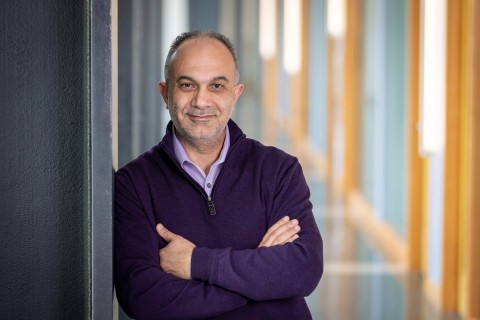
California State University, Los Angeles, is pleased to welcome Professor Omar K. Farha of Northwestern University as the featured speaker for the Jean Dreyfus Lectureship. During his two-day visit, Professor Farha will present a scientific seminar and a public lecture and engage with Cal State LA students and faculty through research discussions and informal conversations.
September 17
Scientific Seminar
Metal-Organic Frameworks from Inception to Commercialization
Thursday, September 17, 2026
3:00–4:30 p.m.
BIOS 144
Coffee and light refreshments will be served.
Abstract
As chemists and materials scientists, it is our responsibility to design and develop materials that address critical societal needs, including efficient and sustainable separation technologies. Since the inception of metal-organic frameworks (MOFs), researchers have explored various design strategies to rationally synthesize new MOF materials, investigate their porosity and adsorption properties, and integrate them into functional systems for real-world applications. MOFs are a class of porous, crystalline materials composed of metal-based nodes and organic ligands that self-assemble into multidimensional lattices. Unlike conventional porous materials, the vast diversity of molecular building blocks enables the precise tuning of MOF properties, making them highly effective for selective separations. MOFs have demonstrated significant potential in applications including gas separations, water purification, hydrocarbon separations, and rare-earth element recovery. In our research, we have developed an extensive understanding of how the physical architecture and chemical composition of MOFs influence their separation performance. By tailoring pore size, surface chemistry, and framework flexibility, we have designed MOFs that exhibit exceptional selectivity and efficiency in challenging separation processes. This presentation will highlight recent advances in MOF-based separation technologies.
September 18
Dreyfus Lecturer Luncheon with Students and Faculty
12:00–1:00 p.m.
Golden Eagle Ballroom
Students and faculty are invited to join Professor Farha for an informal luncheon and conversation.
Advance RSVP is required for the luncheon. Space is limited.
RSVP for Luncheon (Please RSVP by Sep. 14)
The public lecture will begin immediately following the luncheon in the same room.
Jean Dreyfus Public Lecture
Programmable Smart Crystalline Sponges for Protection
1:15–3:00 p.m.
Golden Eagle Ballroom
Free and open to the public. No RSVP required for the public lecture.
Abstract
Eighty years ago, polymers were largely unfamiliar to the general public. However, the late 1930s saw the emergence of nylon, which quickly became a household name, revolutionizing the women’s hosiery market and signaling the start of a materials revolution that unfolded over decades. As a result, polymers evolved into essential components across various sectors, including clothing, kitchenware, electronics, building materials, and medicine, establishing themselves as one of the defining materials of the 20th century. Looking forward, metal-organic frameworks (MOFs)—often described as “smart and programmable sponges”—are set to become hallmark materials of the 21st century. Despite being in the early stages of development, the potential of MOFs is immense. In 50 years, they could be as integral to daily life as polymers are today. MOFs can be visualized as nano-scale Tinker Toy structures, where metal nodes and organic linkers create highly ordered, periodic arrangements. This modular architecture grants MOFs exceptional versatility and tunability, opening the door to a diverse range of applications. Researchers globally are actively investigating their potential in areas such as drug delivery, gas storage, chemical separations, neutralization of toxic agents such as nerve gases, and water harvesting. Importantly, the commercialization of MOFs has commenced, driven by start-up companies that are translating laboratory research into practical, real-world applications. This presentation will explore the transformative potential of metal-organic frameworks, emphasizing their role as enabling materials for environmental solutions. From foundational scientific discovery to implementation and commercialization, MOFs are paving the way for innovative responses to some of society’s most pressing challenges.
About Professor Omar K. Farha
Omar K. Farha is Chair of the Department of Chemistry and the Charles E. and Emma H. Morrison Professor of Chemistry at Northwestern University. He is also an Executive Editor for ACS Applied Materials & Interfaces and President of Numat Technologies. His research spans chemistry and materials science, with applications ranging from energy to defense-related challenges. His work is particularly recognized for the development and application of metal-organic frameworks and other porous materials.
Professor Farha was named a 2025 Fellow of the National Academy of Inventors and received the 2025 ACS Award in Inorganic Nanoscience. His other honors include election as a Fellow of the European Academy of Sciences, the Japanese Society of Coordination Chemistry International Award for Creative Work, the Royal Society of Chemistry Environment, Sustainability and Energy Division Early Career Award, the ACS Satinder Ahuja Award for Young Investigators in Separation Science, and the ACS ENFL Emerging Researcher Award.
He has authored more than 700 peer-reviewed publications, holds 17 patents, has received more than 135,000 citations, and has an h-index of 182 according to Google Scholar. He has been named a Highly Cited Researcher from 2014 through 2025.
About the Jean Dreyfus Lectureship
The Jean Dreyfus Lectureship for Undergraduate Institutions, a program of the Camille and Henry Dreyfus Foundation, brings distinguished researchers in the chemical sciences to institutions with a strong commitment to undergraduate education. The program gives students and faculty opportunities to engage directly with leading scientists through lectures, discussions, and other scholarly activities. Cal State LA received the Jean Dreyfus Lectureship award in 2024 to support Professor Farha’s visit.
Undergraduate Research Supported by the Jean Dreyfus Lectureship
The Jean Dreyfus Lectureship award also supported two Cal State LA undergraduate students in conducting intensive summer research in the Department of Chemistry and Biochemistry during summer 2025. Working closely with faculty mentors, the students gained hands-on experience in cutting-edge chemical research while advancing their preparation for graduate study and careers in science. Their summer research experiences and projects are highlighted below.
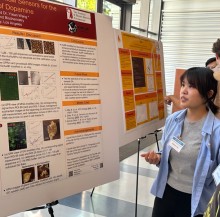
Madison Ngo (Faculty Mentor: Dr. Yixian Wang)
Research Project: Modified Plasmonic Electrochemical Sensors for the Sensitive Detection of Dopamine. Madison investigated modified plasmonic electrochemical sensors for the sensitive detection of dopamine. Her project evaluated gold nanoparticles, 6-mercaptohexanoic acid, and graphene oxide as sensor modifications to improve dopamine detection, with the long-term goal of enabling real-time monitoring of dopamine release from cells.
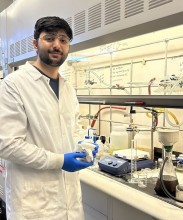
Aram Sahinyan (Faculty Mentor: Dr. Yangyang Liu)
Research Project: Synthesis and Functional Applications of Metal-Organic Frameworks for Gas Storage, Chemical Protection, and Drug Delivery. Aram explored the synthesis and functionalization of metal-organic frameworks and related compounds for applications in gas storage, chemical protection, and drug delivery. His work included synthesizing and characterizing MOF-808 and NU-1000, preparing molecular precursors, and developing materials intended for future studies in gas adsorption, detoxification, and RNA delivery
Visit Cal State LA
Scientific Seminar: BIOS 144 (in the Biological Sciences Building)
Luncheon and Public Lecture: Golden Eagle Ballroom
California State University, Los Angeles
5151 State University Drive
Los Angeles, CA 90032
Campus Map
Visitor Parking Information
Contact
Prof. Yangyang Liu
Department of Chemistry and Biochemistry
California State University, Los Angeles
Email: [email protected]
Phone: 323-343-2323
Hosted by the Department of Chemistry and Biochemistry, College of Natural and Social Sciences, California State University, Los Angeles.