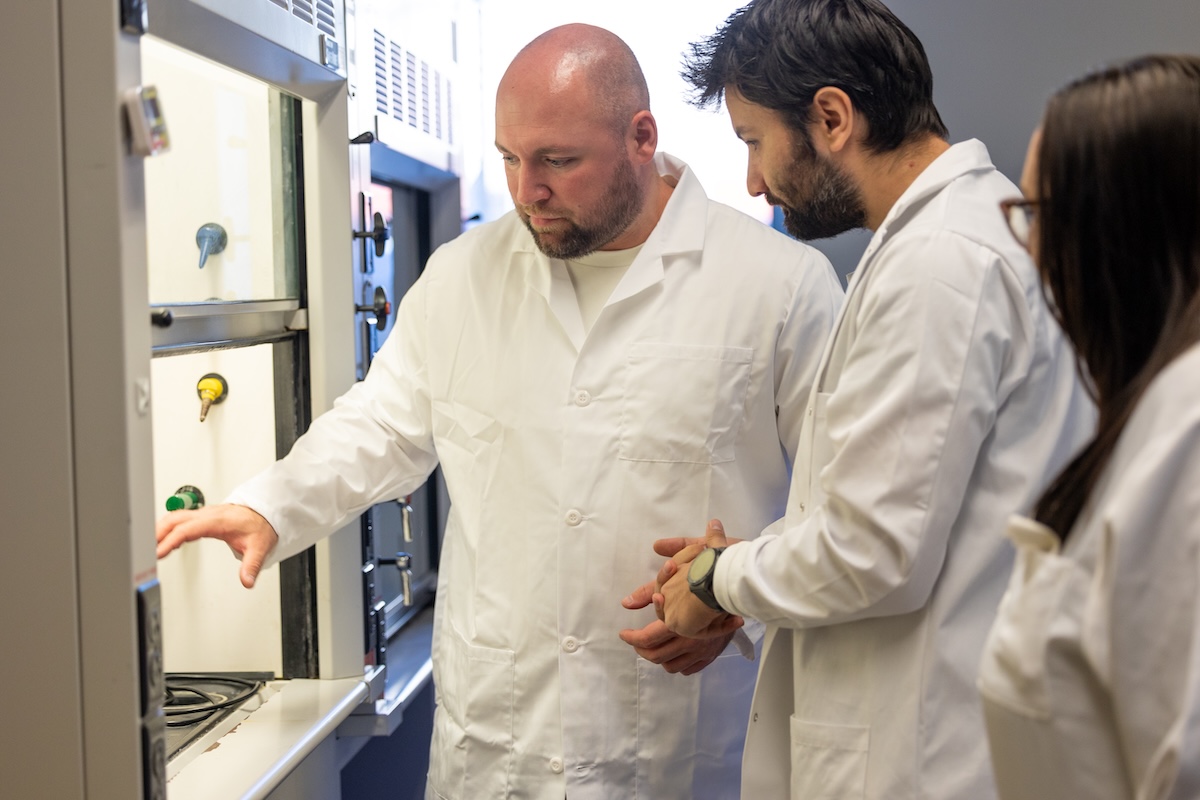
The Analytical Scientist recognizes the chemistry professor among 40 emerging leaders helping shape the future of analytical science.
Petr Vozka, an associate professor in the Department of Chemistry and Biochemistry at Cal State LA, has been named to The Analytical Scientist's 2026 Top 40 Under 40 Power List, a competitive international recognition highlighting rising leaders whose research and contributions are helping shape the future of analytical science.
Established in 2013, the publication's Power List celebrates scientists making significant contributions to the field. The Top 40 Under 40 edition, first introduced in 2014, recognizes emerging researchers selected through an independent judging process. Honorees represent a range of scientific disciplines, institutions and research specialties.
Vozka was recognized for his work investigating complex chemical mixtures, including plastic-derived fuels, microplastics and environmental materials. His research uses advanced analytical techniques, including comprehensive two-dimensional gas chromatography, mass spectrometry and computational data analysis, to identify chemical compounds and better understand their properties and behavior.
His work addresses environmental and engineering challenges, particularly the conversion of plastic waste into useful chemicals and fuels and the behavior of microplastics and associated compounds in the environment. By analyzing materials that can contain thousands of chemical components, Vozka and his research group seek to transform complex scientific data into meaningful findings.
In his profile for The Analytical Scientist, Vozka emphasized the importance of looking beyond the growing capabilities of scientific instruments to understand what their measurements actually reveal.
“We now have instruments capable of showing us extraordinary chemical detail. The next frontier is deciding what that detail means,” he said.
Vozka also highlighted the increasing influence of artificial intelligence in analytical chemistry. While AI offers opportunities to identify patterns in large and complex datasets, he cautioned that its effectiveness depends on the quality of the underlying scientific measurements and researchers' ability to interpret the results.
“AI can find a convincing pattern in bad data just as efficiently as it can find one in good data,” he said.
The recognition places Vozka among an international group of emerging scientists whose work reflects the evolving landscape of analytical science, from advances in instrumentation and environmental research to the expanding role of artificial intelligence.