African Indigenous Knowledge Systems: Languages and Civic Traditions in South Africa
Mutual Educational and Cultural Exchange (MECE) Program
Year 1 of 3: isiZulu Language and South African Area Studies
We are proud to announce that the Department of Pan-African Studies in the College of Ethnic Studies at Cal State LA has received a Mutual Educational and Cultural Exchange (MECE) grant from the U.S. Department of Education, awarded in coordination with the U.S. Department of State's Bureau of Educational and Cultural Affairs.
The three-year project, African Indigenous Knowledge Systems: Languages and Civic Traditions in South Africa, Senegal, and Kenya, will take a cohort of U.S. teachers and prospective teachers abroad each summer: South Africa (isiZulu) in 2027, Senegal (Wolof) in 2028, and Kenya (Kiswahili) in 2029.
In Summer 2027, a cohort of teachers and prospective teachers from U.S. schools, colleges, and universities will spend five weeks in South Africa. Participants will study isiZulu and examine how language carries civic values, historical memory, and public life in South Africa's constitutional democracy.
Participants will also study founding documents of the American political tradition, including the U.S. Constitution and the Federalist Papers, and compare how the United States and South Africa designed their representative institutions.
Participants return home with assessed gains in isiZulu, primary sources and teaching materials gathered in South Africa, and a role in authoring one of the cohort's peer-reviewed instructional modules. The finished modules will be openly licensed and posted on the Pan-African Studies website for educators nationwide.
Program Overview
Program details, important dates, and eligibility information for Summer 2027.
| Program | Mutual Educational and Cultural Exchange (MECE) Program, Year 1 |
|---|---|
| Country and language | South Africa; isiZulu (Zulu) |
| Host institution | University of KwaZulu-Natal, Durban |
| Provinces | Gauteng, Western Cape, and KwaZulu-Natal |
| Who may apply | U.S. citizens and permanent residents who teach, or are preparing to teach, in U.S. schools, colleges, or universities |
| Prior isiZulu | Not required |
| Application deadline | Tuesday, December 1, 2026, 11:59 p.m. Pacific Time |
| Participant program fee | $400 |
| Application deadline | Tuesday, December 1, 2026, at 11:59 p.m. Pacific Time |
|---|---|
| Selection notification | Monday, December 21, 2026 |
| Pre-departure orientation (virtual, required) | Monday, June 21 to Friday, June 25, 2027 |
| Program abroad | Friday, July 2 to Saturday, August 7, 2027 (five weeks) |
| Depart the United States | Friday, July 2, 2027 |
| Return to the United States | Saturday, August 7, 2027 |
| Post-program curriculum workshops | Fall 2027 |
| Module implementation and outreach activity | Within six months of return (by February 7, 2028) |
To be eligible, applicants must:
- Be a U.S. citizen or permanent resident.
- Currently teach, or be preparing to teach, in a U.S. school, college, or university.
- If applying as a prospective teacher, have a minimum 3.0 GPA or equivalent evidence of academic excellence.
- Be able to take part in every program component: the virtual pre-departure orientation (June 21–25, 2027), the full five weeks in South Africa (July 2 to August 7, 2027), the fall 2027 curriculum workshops, and the six-month follow-up.
The program is designed for teachers and prospective teachers at every level of U.S. education:
- K–12 teachers
- Faculty and instructors at U.S. colleges and universities, including community colleges
- Prospective teachers: students preparing for a teaching career, such as those in a teacher-preparation or credential program, or graduate students preparing to teach at the college level (minimum 3.0 GPA or equivalent evidence of academic excellence)
We especially encourage applications from educators who teach, or will teach, world languages; social studies, U.S. history, civics, or government; ethnic studies; Pan-African, Africana, or African American studies; African studies; and English or literature.
Educators implementing California's ethnic studies requirements, AB 101 for high school graduation and AB 1460 for California State University undergraduates, will find the program's materials directly applicable.
We also encourage applications from educators in the California State University system, school districts across the country, and U.S. military sector educators.
Curriculum
The 2027 program has seven components:
Pre-Departure Orientation
A required five-day virtual orientation (June 21–25, 2027) covering travel preparation, an introduction to isiZulu, and the program's academic goals.
isiZulu Language Instruction
Daily classroom instruction and conversation practice with native speakers. No prior knowledge of isiZulu is required.
Lecture Seminars
Seminars led by South African scholars and experts on language, culture, history, and civic life.
Educational Visits
Visits to historical, cultural, and civic sites in Gauteng, the Western Cape, and KwaZulu-Natal.
School Visits and Educator Mentorship
Visits to South African schools, with each participant paired with a South African educator mentor.
U.S. Founding Documents
Study of the founding documents of the American political tradition alongside South Africa's civic traditions.
Curriculum Development
Participants develop instructional modules for U.S. classrooms, refine them in fall 2027 workshops, and share them with other educators.
South African educators will also visit Cal State LA as part of the MECE exchange.
Application & Funding
Information about program costs, financial support, application requirements, selection, and participant commitments.
What the MECE Grant Covers
The MECE grant covers the main costs of the program:
- Round-trip international airfare between the program's designated U.S. departure airport and South Africa.
- Lodging for the five weeks in South Africa.
- Program-related transportation within South Africa.
- isiZulu instruction, lecture seminars, and the educator mentorship program.
- Admission to museums and heritage sites on the program itinerary.
- Program teaching materials.
- The virtual pre-departure orientation and the fall 2027 curriculum workshops.
- A weekly stipend, which participants are expected to use to cover meals.
- Travel health insurance provided by Cal State LA.
- Dissemination support, with participants encouraged to first seek departmental funding for travel expenses.
- Conference funding for K–12 educators and prospective teachers (e.g., graduate students) presenting instructional modules developed through the program. College educators are encouraged to first seek travel funding from their departments or institutions before requesting project funds for conference-related expenses.
Participant Expenses
Participants are responsible for:
- Participant program fee of $400.
- Travel between home and the designated U.S. departure airport (i.e., Newark on the East Coast and LAX on the West Coast), before and after the program.
- Passport fees and visa fees if your passport requires a visa for South Africa.
- Immunizations and other travel-related health expenses.
- Travel taken on your own before or after the program.
- Personal shopping and gifts.
We encourage participants to ask their schools, districts, departments, or institutions for support with the program fee and domestic travel to the designated U.S. departure airports.
Applications are submitted online. Before you begin, gather the following:
- A current resume or curriculum vitae.
- Two letters of recommendation to upload with your application. Letters that confirm your institution's support for teaching and sharing your module strengthen your application.
- Graduate students only: Transcripts or equivalent evidence of academic preparation (prospective teachers must show a minimum 3.0 GPA or equivalent).
- Graduate students only: Evidence of your current or prospective teaching role, such as a letter from your school or department, a current teaching assignment, or proof of enrollment in a teacher-preparation program.
Essay Questions
You will also answer three essay questions:
- Statement of interest (minimum 250 words): Why are you applying to this program, and what do you hope to gain from studying isiZulu and South Africa's civic traditions?
- Preliminary curriculum development plan (minimum 250 words): Describe the course and students you teach or will teach. Outline a module you could develop, including its learning objectives, the standards it would address, how it would pair a South African source with a U.S. founding document or primary source, how you would assess student learning, and where you would teach and share it within six months of the program.
- Readiness for international study (minimum 125 words): What parts of your background, coursework, language study, travel, or work experience have prepared you to live and study in South Africa for five weeks as part of a group?
Application Deadline: December 1, 2026
Applications must be submitted by 11:59 p.m. Pacific Time.
A five-member selection committee reviews every application. The committee is chaired by the Project Director and includes the Project Coordinator, a U.S.-based program coordinator, and two College of Ethnic Studies faculty members.
Two committee members score each application independently. When their scores differ by more than 10 points, a third member reviews the application.
U.S. citizens who have served in the U.S. Armed Forces receive preference, applied when applicants fall within the same scoring band.
Applicants will be notified of the outcome by Monday, December 21, 2026. Selected participants will receive pre-departure information in March 2027.
Selected participants agree to:
- Attend all five days of the virtual pre-departure orientation, June 21–25, 2027.
- Take part in all scheduled activities for the full five weeks in South Africa.
- Complete the program's starting and ending language assessments and knowledge surveys, and keep a field journal.
- Help author one of the cohort's instructional modules and revise it through the fall 2027 workshops.
- Teach the module and submit an implementation report within six months of return.
- Complete at least one outreach activity (workshop, presentation, or publication) within six months of return.
- Release final modules under an open license for public posting.
The program schedule is full. Participants will build professional contacts with South African academics and educators, but there is no time to pursue personal research or projects unrelated to the program.
Additional Information
Learn about upcoming MECE programs, explore curriculum from previous cohorts, and find program contact information.
Senegal, Summer 2028
Wolof language and Senegalese area studies with the Linguistics Laboratory of IFAN-Cheikh Anta Diop at Université Cheikh Anta Diop de Dakar, coordinated in Senegal.
Recruitment: Planned to begin in fall 2027.
Kenya, Summer 2029
Kiswahili language and Kenyan area studies with the Department of Kiswahili at the University of Nairobi, coordinated in Kenya.
Recruitment: Planned to begin in fall 2028.
Each country's program has its own cohort and application. Announcements will be posted on this website.
Explore Curriculum from the 2025 Cohort
See curriculum modules developed by participants in the 2025 Fulbright-Hays Group Projects Abroad Program and discover how they incorporated their experiences with Zulu language and culture and Indigenous African health and healing practices into U.S. curricula.
Explore Curriculum from the 2023 Cohort
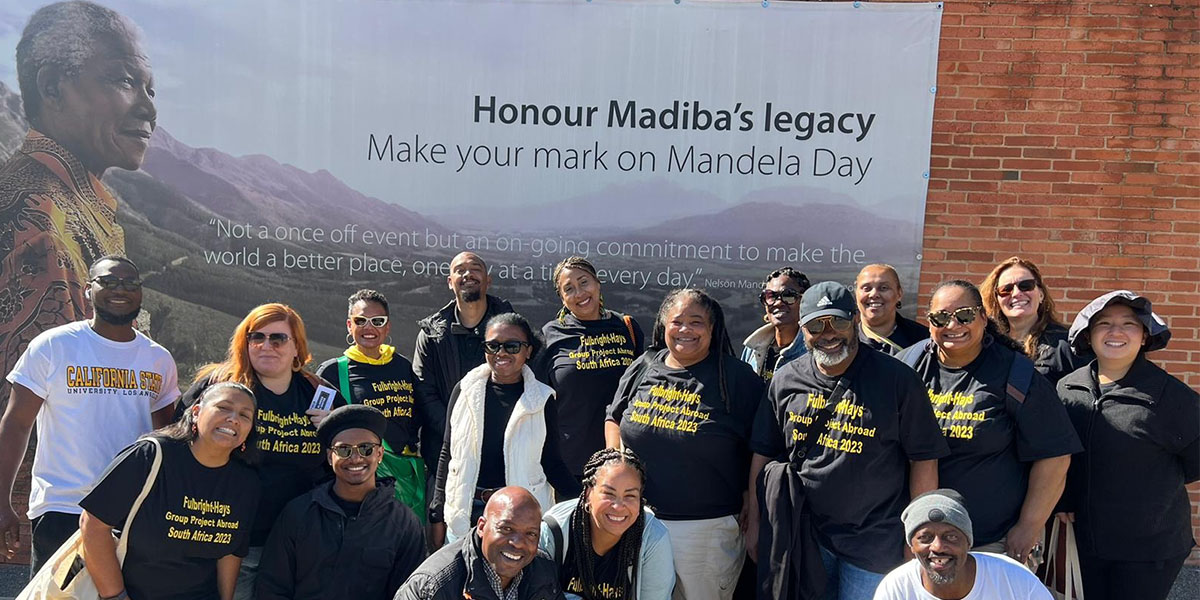
See curriculum modules developed by participants in the 2023 Fulbright-Hays Group Projects Abroad Program and discover how they incorporated their experiences in South Africa into classroom instruction.
Program Contacts
Please contact the Project Coordinator or Project Director with any questions.
Professor Zama Dlamini
Co-Principal Investigator and Project Coordinator, MECE Program
Pan-African Studies Department
Email: [email protected]
Phone: 323-343-2290
Dr. Serie McDougal, III
Project Director and Principal Investigator, MECE Program
Pan-African Studies Department
Email: [email protected]
Phone: 323-343-2290