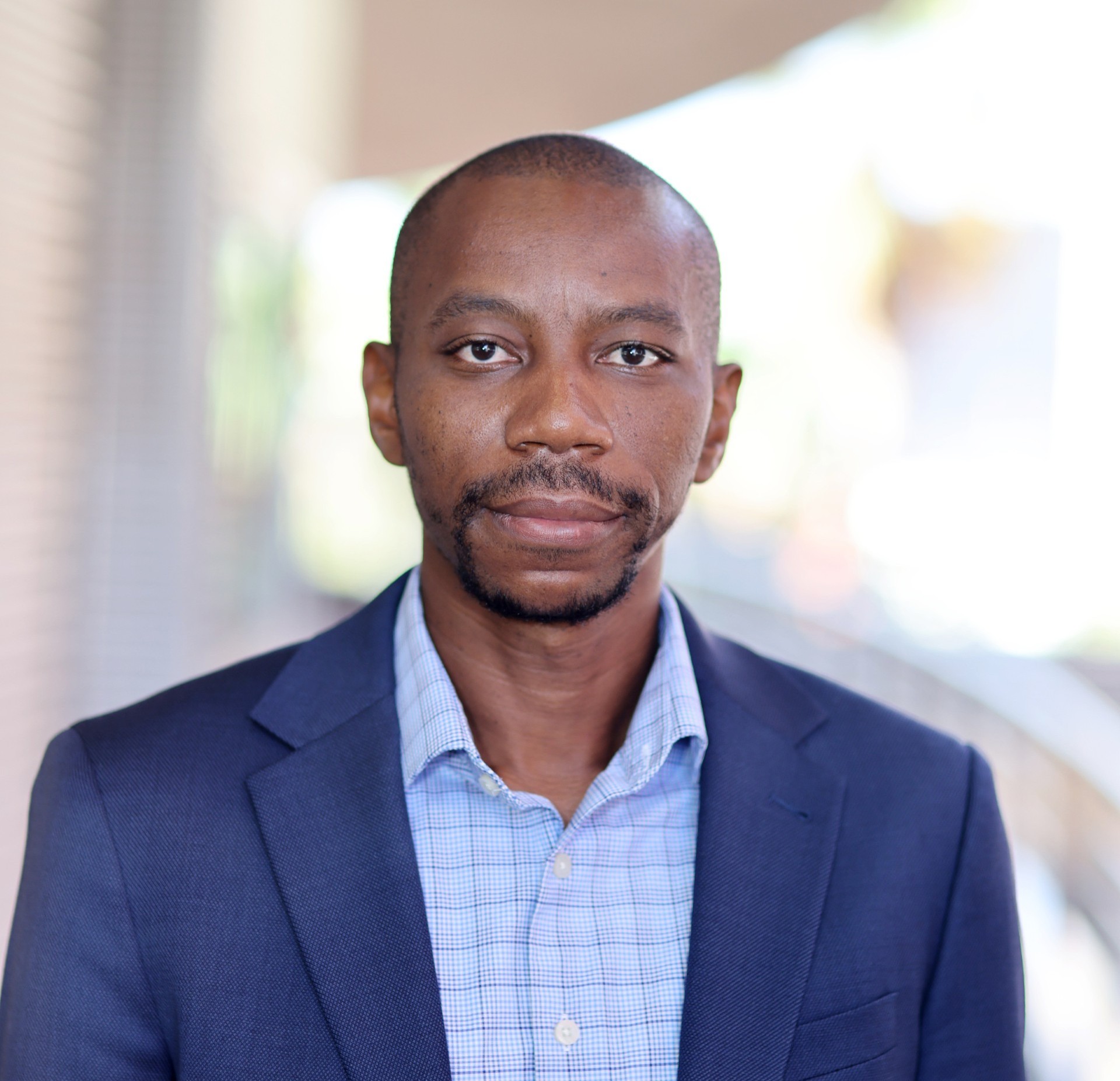
Dr. Etim has been at Cal State LA for the past four years. He is a faculty member in the Department of Public Health. He teaches courses on epidemiology, data analysis, and biostatistics.
Get To Know Dr. Ndifreke Etim
Tell us a little about your teaching at Cal State LA—how long you’ve been here, what department you’re part of, and the courses and students you work with.
I’ve taught in public health at Cal State LA for 4 years. I teach Introduction to Epidemiology, Data Analysis, and MPH Biostatistics. I teach mostly public health majors, many of them first-generation students who are working while they take a full load, and many of whom arrive convinced they are bad at math. We work to change that though and provide some practice with reasoning and working with data.
What drew you to teaching, and what do you enjoy most about teaching Cal State LA students?
I came to teaching as a lifelong learner. Teaching is how I have always learned, even as a student. While in my Masters, I joined a Peer-Assisted Learning group and that experience ultimately led me to teaching. What I enjoy most here is that Cal State LA students bring the context with them. When we talk about public health exposures, outcomes or inequity, someone in the room has lived near the problem. That means I leave most semesters learning something I didn’t before.
Can you share a moment in your teaching—perhaps an “aha” moment when you saw learning click for a student, or an especially positive experience you shared with a student or class—that has stayed with you?
The moment repeats every semester. Most students have never taken epidemiology, so they arrive certain they know what a case count means and what an outbreak headline in the news is telling them; and they leave questioning all of it. What sticks with me is watching the certainty go. By the end they hedge, they ask where the number came from, and they want to know what the data can’t tell them.
Tell us about the teaching practice you’re sharing. Where do you use it, and what does it look like from a student’s perspective?
We wrote a baseline AI policy for the major. The policy is a research-based framework for deciding when these tools help and when they get in the way, kept at a high-level so it holds across every course. The clearest line in the policy discourages AI use in foundational courses, while a student is still building a skill. Faculty can depart from the baseline as long as they tell students how. From a student’s perspective, the rules don’t change course-to-course, and they come with a reason instead of a prohibition.
What led you to try this practice? Was there a learning goal, student need, or teaching challenge you were trying to address?
Students were already using these tools, and our syllabi were silent or prohibitive. Meanwhile, the question of if this is cheating, even though employers use this tool, remained unanswered. We wanted a policy that is guided by some research, that could hold across different classes.
How does this practice make learning more student-centered?
It treats students as people making a judgment call rather than suspects. A complete ban was unlikely to work given how prevalent AI use was, and policing it could have cost us the relationship without changing the behavior. So the policy gives students the reasoning, why AI use undercuts a skill that is still being learned.
How do you think this practice prepares students for what comes next, whether that’s the workplace, graduate school, or another path?
A component of the policy is disclosing permitted AI use. Most professional settings have adopted disclosure of AI use as a required part of any product and students learn what will be expected of them in these settings.
If a colleague wanted to adapt this practice, what would you want them to know, and where should they start?
Do it as a department. Scattered AI policies across classes leave students juggling contradictory rules in one semester. A student may struggle to build judgment out of that contradiction. Enforcing a policy that differs from peers in the same department is also challenging. So start with a conversation among colleagues. Get agreement on what your field expects of anyone practicing in it, and write the baseline from there.
What do you hope sharing this practice adds to conversations about teaching at Cal State LA?
I hope it moves the conversation away from detection and away from catching cheating students. The detectors out there are unreliable. Falsely accusing a student costs you the relationship and the trust, and students learn to hide the use rather than think about it. I’d rather we ask what each assignment or task is supposed to build and whether using AI aids or impedes learning in that context.
What do you enjoy doing when you’re not teaching?
When I’m not teaching, I enjoy playing soccer, reading, gardening, and home automation.