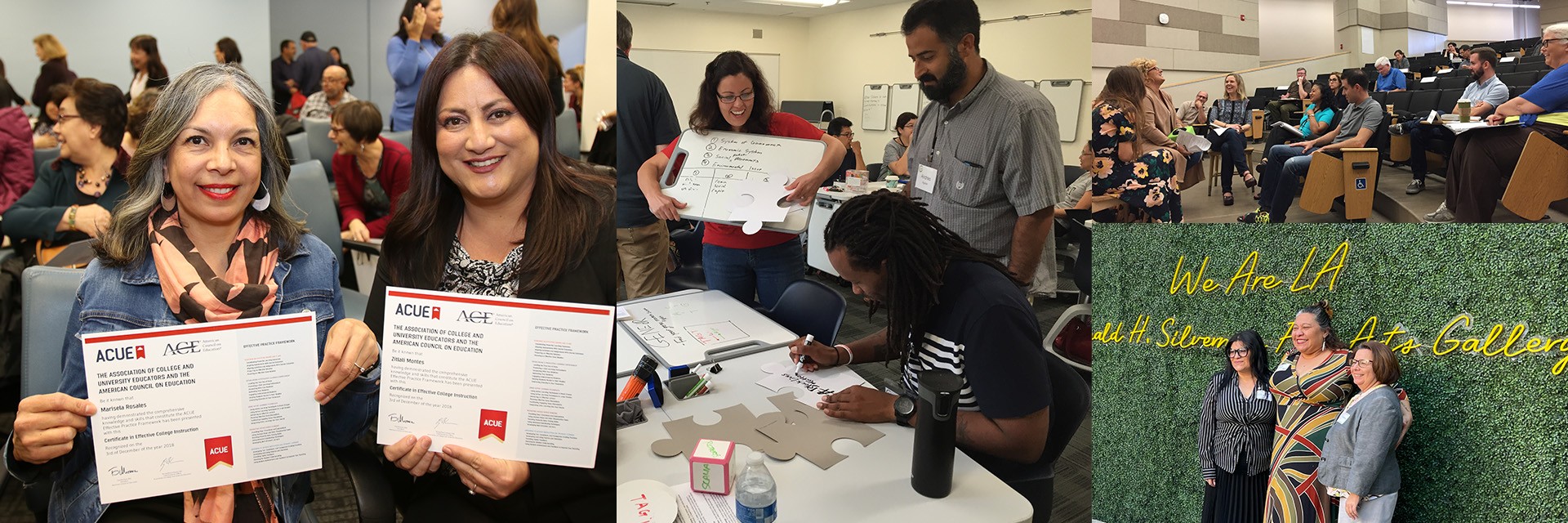
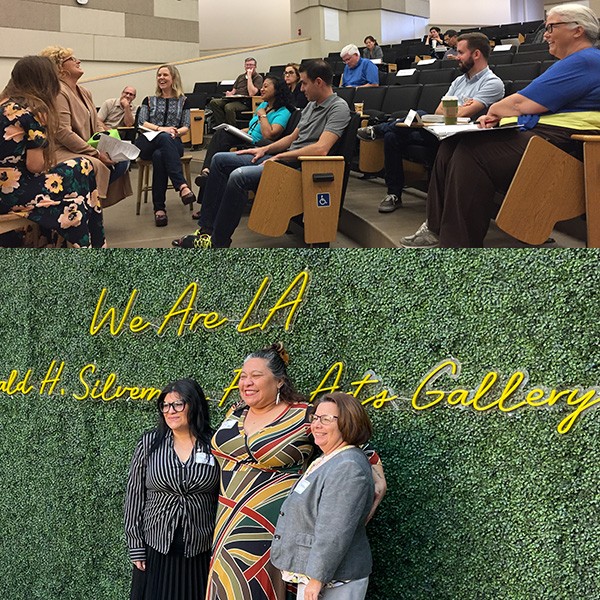
Cal State LA is the first campus nationally to receive the "NACE Curriculum Endorsement" from the National Association of Colleges and Employers. NACE recognizes the “program has the potential to change the conversation around faculty engagement in career-integrated learning" and "offers a leading example for how to embed career readiness into the academic experience.” (NACE, 2026).
Introduction
Career Readiness: Teaching with the Future in Mind is an online, asynchronous program that supports faculty in embedding career readiness into their curriculum.
Although career readiness is widely discussed in higher education, it is often misunderstood as vocational training or as an approach that conflicts with the broader purposes of higher education. This program instead presents career readiness as a discipline-informed pedagogy that can deepen students’ understanding of course content, strengthen their connection to the field, and help them recognize and articulate the transferable skills they learn in the classroom.
Program Overview
Career Readiness: Teaching with the Future in Mind takes an equity-minded look at the professional abilities the workplace will demand of Cal State LA graduates and guides faculty in developing discipline-specific teaching materials that help students build durable skills that will benefit them in any future career. Over the course of the program, faculty will hear directly from Cal State LA students about how career readiness benefits them and from Cal State LA faculty about how they integrate career readiness into their teaching.
What is Career readiness?
In the past decade, many stakeholders, including campuses and employers, have tried to codify career-relevant outcomes (American Association of Colleges and Universities, 2022; National Association of Colleges and Employers, 2021). These sets of knowledge, skills, and dispositions manifest differently in their application to student learning. Broadly speaking, career-relevant learning cuts across disciplines and can be developed through intentional curricular experiences, regardless of the content being taught. These competencies anticipate the changing world of work. Moreover, many of these are already being featured in the classroom—but students may lack awareness of how these skills, as they are currently taught, explicitly relate to community and workplace settings. In the wake of the pandemic, the national discussion on professional learning has intensified.
This program introduces faculty to the NACE Career Readiness Framework, which identifies eight core competencies that employers seek in new graduates. The NACE Career Readiness Competencies include career and self-development, communication, critical thinking, equity and inclusion, leadership, professionalism, teamwork, and technology. The framework gives students a common language for recognizing the skills they develop in your classroom and helps them clearly communicate their experience to employers.
Faculty participating in the program will learn how to adapt the NACE competencies to their disciplinary teaching so that students understand the unique skills and experiences they build in their classes. The program modules help faculty design course descriptions, activities, assignments, and assessments that integrate NACE and help students build and articulate the durable skills faculty teach.
Program Modules
This program is designed as an asynchronous, self-paced course that adapts the original workshops from the Career-Engaged Departments Program into standalone modules. Each module includes a deliverable assignment that asks faculty to apply what they’ve learned in a submission designed to enhance their understanding of career readiness and/or create course content. Faculty can complete the entire course or select individual modules that best meet their needs. Modules include:
Module 1 - Student Perspectives on Career Readiness introduces faculty to the NACE framework, job outlook data for students, and what students want faculty to know. Designed by Cal State LA students.
Module 2 - Career-Engaged Teaching in the Discipline helps faculty adopt NACE as a discipline-informed pedagogy. Designed by Dr. Kristen Discola.
Module 3 - Designing with NACE helps faculty integrate NACE into course descriptions, activities, assignments, and assessments.
Module 4 - Aligning our Students' Academic and Career Plans helps faculty integrate resources from Cal State LA's Career Center into their course materials. Designed in collaboration with Michelle Lovasz, Executive Director of Cal State LA's Career Center.
Module 5 - Group Work is Professional Practice helps faculty design group work to develop durable skills.
Module 6 - Reading and Writing for Career Relevancy helps faculty design reading and writing activities to support human-centered skill development. Designed by Dr. Margaret Finnegan.
To get the most out of this program, we recommend that faculty:
Identify a specific course into which they want to embed the NACE competencies.
Build teaching materials for this course.
Complete Modules 1-4 in order, as they are designed to build upon one another.
Complete Modules 5 and 6 based on the type of assignments faculty teach in their nominated course.
Program contributors
Career Readiness: Teaching with the Future in Mind and the Career-Engaged Departments Program were developed over years of collaboration among CETL, Faculty Fellows, and Subject Matter Experts. The following faculty and subject matter experts contributed to the development of the program.
Dr. Marla A. Parker, Associate Professor, Political Science
Dr. Tanya Sanabria, Associate Professor, Sociology
Dr. Devika Hazra, Professor, Economics
Dr. Margaret Finnegan, Lecturer, Criminal Justice
Dr. Kristen Discola, Associate Professor, Sociology
Dr. Michelle Hawley, Professor, English
Michelle Lovasz, Executive Director, Career Center
Dr. Jason Chiu, Assistant Professor, Asian and Asian-American Studies
Past Programming: Career-Engaged Departments Program, 2022-2026
Introduction
The Career-Engaged Departments Program—one of the first of its kind in the country—was a yearlong faculty learning community that supported departments to embed career readiness into their curriculum.
Run from 2022-26, the Career-Engaged Departments Program took an equity-minded, critical look at the professional abilities that the workplace will demand from graduates, including problem solving, working in a world where AI is increasingly pervasive, communication with technology, problem diagnosis, and critical reading/writing. Working collaboratively in department teams, faculty modified their courses to meet student-centered learning outcomes aligned with National Association of Colleges and Employers (NACE) career readiness competencies.
Program Overview
Over the course of the two-semester program, a team of department faculty worked to embed career-readiness into their curriculum and submit modified courses that met student-centered, career-engaged learning outcomes.
Department teams consisted of at least six faculty members worked together to build “career-engaged” content into three nominated courses, at least one of which must be a General Education (GE) course.
Teams consisted of 3 Lead Designers (one per nominated course) who were Tenure-Track faculty who regularly taught the course, along with at least 3 additional Team Members, who regularly taught at least one of the nominated courses. Lecturers were also invited to participate.
Teams worked together to participate in six workshops and six department team meetings, and to create/embed four team-created career-relevant deliverables into each of their three nominated courses.
What is Career Engagement?
In the past decade, many stakeholders, including campuses and employers, have tried codifying career-relevant outcomes (American Association of Colleges and Universities, 2022; National Association of Colleges and Employers, 2021). These sets of knowledge, skills, and dispositions manifest themselves differently in how they apply to student learning. Broadly speaking, career relevant learning cuts across any single discipline and can be developed through intentional curricular experiences, regardless of the content being taught. These competencies anticipate the changing world of work. Moreover, many of these are already being featured in the classroom—but there may be a lack of awareness by students as to how these skills, as they are currently taught, explicitly relate to community and workplace settings.
In the wake of the pandemic, the national discussion on professional learning has intensified. The Cal State LA Career-Engaged Departments program uses the NACE Career Readiness Competencies as a framework for career learning at Cal State LA. The 2026 NACE competencies include:
- Career and Self-Development
- Communication
- Critical Thinking
- Equity and Inclusion
- Leadership
- Professionalism
- Teamwork
- Technology
Faculty participating in the series will learn to integrate NACE competencies into their courses in ways that honor the spirit of the discipline while making the connection between college and work explicit.
Career-Engaged Departments Workshops
Over the course of the program, department teams participated in six 90-minute, synchronous workshops in the Career Engaged Teaching series. Following live workshop sessions, faculty teams held team meetings and collaborate to complete four program deliverables. The workshops included:
- Introduction to Career Ready Learning
- Group Work is Professional Practice
- Teaching using Disciplinary Values
- Problem-solving in the Discipline
- Reading and Writing for Careers
- Collaborating with the Career Center
Career-Engaged Departments Showcase
Over 154 faculty and 22 Departments have completed the Career-Engaged Departments Program.
The 2023-23 cohort: Child and Family Studies, Communication, Criminal Justice-Criminalistics, Technology, Liberal Studies, and Sociology.
The 2023-24 cohort: Accounting, Biological Sciences, Chicana(o) and Latina(o) Studies, English, Management, Marketing, Mathematics, Music, Public Health, and faculty in our Prison Graduation Initiative.
The 2024-25 cohort: Chemistry & Biochemistry, Information Systems, Geography, Geology, and the Environment, History, Nutrition and Food Science, and Television, Film, and Media Studies.
The 2025-26 extension year cohort: Chemistry & Biochemistry, Chicana(o) & Latina(o) Studies, Child & Family Studies, Computer Information Systems, English, History, Liberal Studies, Marketing, Nutritional Sciences, and Television, Film, and Media Studies.
Communication
- Faculty:
- Sierra Bray
- Melissa Deleon
- Kimberli Samuel
- Elaine Wittenberg
English
- Faculty:
- Josh Adachi
- Emily Baird
- Megan Bowe
- Linda Greenberg
- Ronnese Kirton Glover
- Miljan Rahman
Liberal Studies
- Faculty:
- Claudia Diera
- Jamila Guerrero-Cantor
- Alexis Riley
- Mike Willard, Department Chair
Music
- Faculty:
- Linda Rose Hembreiker
- Beverly Stein
Television, Film, and Media Studies
- Faculty:
- April Brown
- Mercedes Chavez
- Michael Clarke
- Shaunelle Curry
- Dalila Droege
- Marcel Giwargis
- Kristiina Hackel
- Julie Liss
- Jane McKeever
- Rachel Pearl
- Nidhin Patel
Accounting
- Faculty:
- Rui (Shelly) Hu
- Dong-Woo Lee, Department Chair
- Gretchen Lawrie
- Nika Qiao
- Xiangge (Angela) Wang
Information Systems
- Faculty:
- Arun Aryal
- LiuLiu (Luna) Fu
- Pamella Howell
- Jose Arriola Ortiz
- Daniel Razmjou
- Ming Wang
Management
- Faculty:
- Ramzan Amiri
- Jannine Mongeon (Schaaf)
- Tara O'Callaghan
- Belarmina Richards
Marketing
- Faculty:
- Sharmin Attaran
- Karen Blackwell
- Kipenzi Chidinma
- Mine Ucok Hughes, Department Chair
- Silvia Martin (Lozano)
- Joe Otto, Department Chair
- Tara Petrin
- Anita Ravani
- Shikha Upadhyaya
- Kelly Eun Jung Yoon
- Irem Yoruk
Technology
- Faculty:
- Ali Adabzadeh
- Yilin Feng
- Pono (John) Van Gieson
- Ankit Gupta
- Rupa Purasinghe, Department Chair
- Josef Velten
Chicana(o) & Latina(o) Studies
- Faculty:
- Cynthia Alonso
- Katherine Batanero
- Dionne Espinoza
- Sonny Richard Espinoza
- Joanna Flores
- Michelle Lopez
- Claudia Mercado
- Anita Revilla
- Diana Solis
- Theresa Yugar
Child & Family Studies
- Faculty:
- Sosseh Didarloo
- Allison Fuligni
- Brie Kohrt
- Yafen Lo
- Jessica Morales-Chicas
- Maitza Morales-Garcia
- Ashley Munger
- Christine Park
- Su-Jeong Wee
- Wook Yang
Criminal Justice-Criminalistics
- Faculty:
- Margaret Finnegan
- Gabriel Ferreyra-Orozco
- Xiaohan Mei
- Carlena Orosco
- Joshua Ruffin
- Bill Sanders
- Nicole Smolter
- Elizabeth Alvarez (Velazquez)
- Tracy Webb
Public Health
- Faculty:
- Evelyn Alvarez
- Ana-Alicia Carr
- Ndifreke Etim
- Wai Ping (Athena) Foong
- Beth Hoffman
- Kimberly Kisler
- Marisa Marcarello
- Stephanie McGuire
- Melanie Sebado-Liwag
- Gregory Stevens
Nutritional and Food Science
- Faculty:
- Carrie Adase
- Maja Broz
- Suzanne Elizondo
- Kimberly Gottesman
- Kathryn (Mandy) Hillstrom, Department Chair
- Eileen Moylan
- Michele Nicolo
- Anureet Kaur Shah
- Jasmine Tom
Biological Sciences
- Faculty:
- Serj Danielian
- Kirsten Fisher, Department Chair
- Tina Givrad
- Lisa Lugo
- Tina Salmassi
- Elizabeth (Lisa) Torres
- Valerie Wong
Chemistry & Biochemistry
- Faculty:
- Brenda Andrade-Rounds
- Okezie Aruoma
- Henry Choi
- Krishna Foster, Department Chair
- Carlos Godinez
- Myeong-Ho Jeong
- Claudia Molina
- Caitlin Scott
- Olaseni Sode
- Petr Vozka
Geography, Geology, and the Environment
- Faculty:
- Michael Beland
- Mohammad Rezaie Boroon
- Jessica Bremner
- Ed Eivers, Department Chair
- Joshua Kelly
- Jingjing Li
History
- Faculty:
- Gregory Beirich
- Dawn Dennis
- Christopher Endy
- Eileen Ford
- Birte Pfleger
- Travis Shutz
- Scott Wells, Department Chair
- Mark Wild
Mathematics
- Faculty:
- Tina Givrad
- Sharona Krinsky
- Daphne Liu, Department Chair
- Jennica Melendez
- Bao Ngo
- Jason O'Neill
- Tuyetdong Phan-Yamada
- Grant Robinson
- Jie Zhong
- Dong Zhou
Sociology
- Faculty:
- Dinur Blum
- Kristen Discola
- Ruzanna Karmiryan
- Ted Manley
- Luis Nuno
- Melanie Stagnaro
- Dmitri Seals
- Vanessa Stout
- Faculty:
- Cynthia Blake
- Jay Conway
- John Dennem
- Dion McKenzie
- Oscar Mejia
- Aya Nakagoshi
- Bidhan Roy, Program Director
- Marcos Santos
- David Thorne
- Matthew Tasaka-Mejia
- Mike Willard
Program Sponsorship
Career-Engaged Departments programming was funded by Éxito! Building Student Support and Faculty Quality, a US Department of Education Developing Hispanic Serving Institutions (DHSI) grant. The goal of the grant was to improve student outcomes by taking an asset-based and equity-focused approach to student success. The Career-Engaged Departments program was offered from AY 2022-26.
References
- American Association of College and Universities. (2022). Essential learning outcomes. https://www.aacu.org/trending-topics/essential-learning-outcomes
- ECMC. (2022, May 32). Why Gen Z cares less about getting a 4-year college degree. https://www.ecmcgroup.org/news/group/why-gen-z-cares-less-about-getting-a-4-year-college-degree
- Fischer, K (2022a, March). New pathway from college to career [White Paper]. Chronicle of Higher Education.
- Fischer, K. (2022b, May 5). The uneven climb from college to career. Chronicle of Higher Education. https://www.chronicle.com/article/the-uneven-climb-from-college-to-career
- Fischer, K. (2022c, July 26). Americans' confidence in higher ed drops sharply. Chronicle of Higher Education. https://www.chronicle.com/article/americans-confidence-in-higher-ed-drops-sharply
- Lobell, K. (2023, September 13). SHRM: Why fewer employers are requiring college degrees. The Burning Glass Institute. SHRM: Why Fewer Employers Are Requiring College Degrees — The Burning Glass Institute
- Manzoni, A., & Streib, J. (2019). The equalizing power of a college degree for first-generation college students: Disparities across institutions, majors, and achievement levels. Research in Higher Education, 60, 577-605.
- Marcus, J. (2021, September 24). College degree doesn’t pay off as well for first-generation grads. Hechinger Report. https://hechingerreport.org/college-degree-doesnt-pay-off-as-well-for-first-generation-grads/
- National Association of Colleges and Employers. (2021). What is career readiness? https://www.naceweb.org/career-readiness/competencies/career-readiness-defined/
- National Student Clearinghouse Research Center. (2022, May 26). Undergraduate enrollment falls 662,000 students in spring 2022 and 1.4 million during the pandemic. https://www.studentclearinghouse.org/nscblog/undergraduate-enrollment-falls-662000-students-in-spring-2022-and-1-4-million-during-the-pandemic/