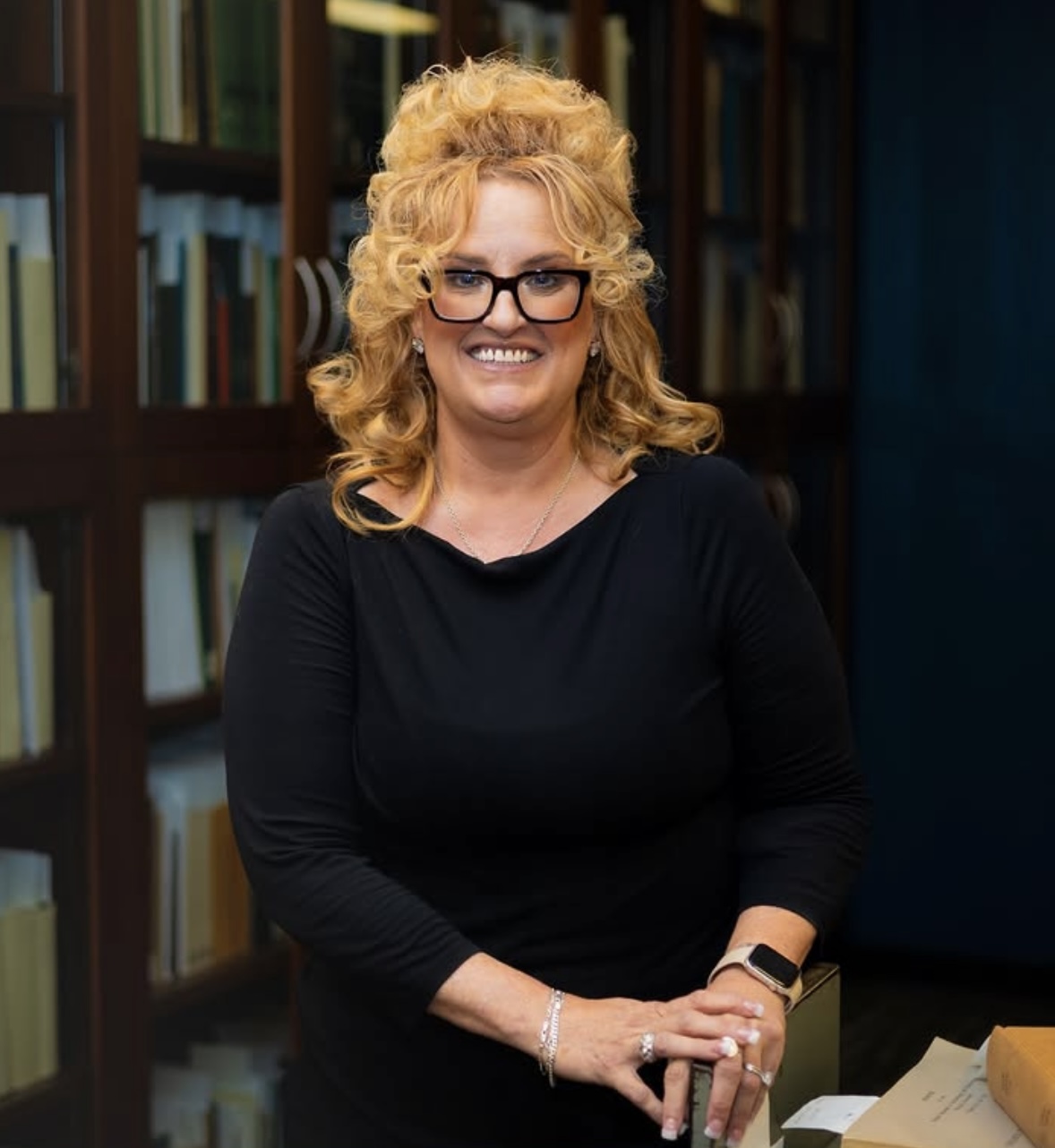
Dr. Dennis has been at Cal State LA since 2014. She is a faculty member in the Department of History, teaching students across the undergraduate curriculum. She is a public historian who designs learning environments that connect students to community-based knowledge, professional pathways, and public-facing scholarship. Dr. Dennis received the Outstanding Lecturer award in Fall 2026, recognizing her excellence in teaching and commitment to student success at Cal State LA.
Get To Know Dr. Dawn Amber Dennis
Tell us a little about your teaching at Cal State LA—how long you’ve been here, what department you’re part of, and the courses and students you work with.
I have taught in the Department of History at Cal State LA for more than a decade, working with students across the undergraduate curriculum, from general education U.S. history courses to upper-division research, writing, and public history courses. My teaching has included HIST 2050: United States History, HIST 2080: California History, HIST 3090: Historical Research and Writing, HIST 4820: History of American Popular Culture, HIST 4710: Revolutionary America, and HIST 4900: Senior Capstone, among other courses. Across these learning environments, I ask students to view history not simply as content to learn, but as a process of inquiry: asking meaningful questions, locating and evaluating evidence, recognizing perspectives and historical silences, developing interpretations, and communicating those interpretations to diverse audiences. I also extend learning beyond the traditional classroom through archives, museums, digital public history, community partnerships, and career-engaged learning. These experiences help students understand that historical thinking has value not only within the discipline, but also across careers, communities, and public life. What makes teaching at Cal State LA especially meaningful to me is our students. They bring cultural wealth, lived and professional experience, family and community histories, languages, and multiple ways of knowing into our classrooms. I see those strengths as part of the intellectual life of the university, and I work to create learning environments where students recognize that they already possess knowledge while developing new tools for historical inquiry.
What drew you to teaching, and what do you enjoy most about teaching Cal State LA students?
I was drawn to teaching because I experienced firsthand how transformative education can be when students encounter educators and learning experiences that allow them to see themselves differently. One of the most formative experiences in my development as a historian and educator was my work in Natchez, Mississippi, with the Natchez Courthouse Records Project. My own development as a historian was shaped by mentors, archives, public history, and experiences that helped me understand that history was not simply something I studied; it was something I could participate in creating and interpreting. What I enjoy most about Cal State LA students is their curiosity, resilience, and connection to the communities around us. I want students to understand that they do not have to leave their identities or experiences at the classroom door. My responsibility is to help them connect that knowledge to historical inquiry, new intellectual tools, and possibilities they may not yet have imagined for themselves.
Can you share a moment in your teaching—perhaps an “aha” moment when you saw learning click for a student, or an especially positive experience you shared with a student or class—that has stayed with you?
Some of my favorite moments occur when students stop asking, “Is this what you want?” and begin asking, “What does the evidence allow me to argue?” That transition is transformative because students begin to recognize themselves as knowledge producers rather than simply recipients of information. I have seen this happen while students work with archival collections, develop research projects, interpret primary sources, or create public-facing historical work. Suddenly, the University archive is not intimidating, and history is not something contained in a textbook. Students recognize that they can ask meaningful questions, evaluate evidence, construct interpretations, and contribute something of their own to a larger historical conversation. Those are the moments when I know learning has moved beyond completing an assignment.
Tell us about the teaching practice you’re sharing. Where do you use it, and what does it look like from a student’s perspective?
The teaching practice I am sharing is the semester-length History Pin online exhibition, which I use in both HIST 2050: United States History and HIST 4710: Revolutionary America. An important part of this work is my ongoing collaboration with the Education Department at the Autry Museum of the American West, which has been a teaching and community partner since 2018. Working with museum educators allows students to encounter public history as a professional practice and to think more intentionally about how historians, museums, archives, and cultural institutions interpret the past for different communities and audiences. I also collaborate with the Cal State LA College Archives and Special Collections, where students encounter original materials and learn how archives preserve, organize, and interpret historical records. Together, the College Archives and the Autry help students experience public history as something practiced in professional spaces rather than something that exists only in textbooks. The History Pin Project asks students to move beyond consuming history and become creators of public-facing historical interpretation. Students select and research a historical person, place, event, object, or story; work with primary and secondary sources; consider questions of perspective, context, audience, and historical significance; and ultimately create a digital History Pin that communicates their interpretation to a public audience. The project looks different depending on the course. In the asynchronous and hybrid HIST 2050 courses, students use History Pin to explore histories connected to the broader themes of U.S. history and community. In HIST 4710, the project is connected to the 250th anniversary of the American Revolution and asks students to consider how histories of revolution, belonging, citizenship, memory, and the unfinished work of the Revolution can be interpreted for contemporary audiences. From a student’s perspective, the project changes the question from “What does my professor want me to write?” to “What story am I trying to tell, what evidence supports it, whose perspectives should I consider, and how can I communicate this history responsibly to other people?”
What led you to try this practice? Was there a learning goal, student need, or teaching challenge you were trying to address?
The History Pin Project grows out of my own development as a historian and public historian who has curated four exhibitions with my students before the 2020 pandemic. My formative work with the Natchez Courthouse Records Project in Natchez, Mississippi, taught me the transformative possibilities of encountering history through archival records, place, and community. That experience shaped my understanding that archives are not simply places where historians retrieve information; they can be spaces of discovery where people encounter lives, communities, and histories that might otherwise remain unseen. I have carried that philosophy into my work at Cal State LA through collaborations with the College Archives and Special Collections and the Education Department at the Autry Museum of the American West. Together, these experiences have continually reinforced my belief that some of the most powerful historical learning happens when students move beyond the textbook and encounter evidence directly. History Pin allows me to bring those experiences together pedagogically. I wanted students to experience some of what had been transformative for me: the realization that history can be discovered in an archive, connected to a place or community, interpreted through evidence, and communicated to others. I also wanted students to understand that their research does not have to end with a paper submitted only to their professor. Historians communicate through museums, archives, historic sites, digital platforms, exhibitions, classrooms, and community projects. History Pin allows students to participate in that broader landscape while developing the critical thinking, research, communication, technology, and career-readiness competencies embedded in historical inquiry.
How does this practice make learning more student-centered?
It changes the student’s role. Rather than asking students simply to reproduce historical information, I ask them to make choices: What question matters? What evidence is useful? Whose perspective is missing? What limitations does this source have? How should this history be communicated? Who is the audience? Students bring their own interests, experiences, communities, and career aspirations into those decisions. That creates a classroom in which students have greater authority over their learning while still receiving the structure, disciplinary guidance, feedback, and intellectual challenge necessary for rigorous historical inquiry. For me, student-centered teaching does not mean lowering expectations. It means creating the conditions in which students can exercise greater intellectual agency.
What have you noticed about how students respond to the practice or what they get out of it?
Students often become more confident and more invested in their work when they understand why they are doing something and know that their work has an authentic audience. When I explicitly identify competencies within an assignment, students begin recognizing that historical study has given them abilities they may have previously overlooked. They can say, “I know how to evaluate conflicting evidence,” “I can communicate complicated information to different audiences,” or “I managed a semester-long research project.” I have also noticed greater investment when students know their work has an authentic purpose, particularly through archives, museums, digital projects, and community-engaged work. The project helps students recognize that their research and interpretations can contribute to conversations beyond the classroom.
How do you think this practice prepares students for what comes next, whether that’s the workplace, graduate school, or another path?
Historical inquiry teaches students to operate in environments where information is incomplete, perspectives conflict, and easy answers may not exist. Through History Pin, I make these connections explicit by linking the project to the NACE Career Readiness Competencies, particularly Critical Thinking, Communication, Technology, Career & Self-Development, and Equity & Inclusion. Students can then articulate not only what they learned historically, but also what they learned how to do. Students learn to ask good questions, find credible evidence, identify context, recognize bias and silences, communicate conclusions, revise when new evidence appears, and engage with people whose experiences differ from their own. Those abilities travel. They matter in graduate school, museums and archives, education, law, government, nonprofit organizations, business, media, community organizations, and many other professional environments. Career readiness, to me, is therefore larger than preparing someone for their first job. It is helping students recognize that they possess adaptable intellectual tools they can carry into changing careers, communities, and lives.
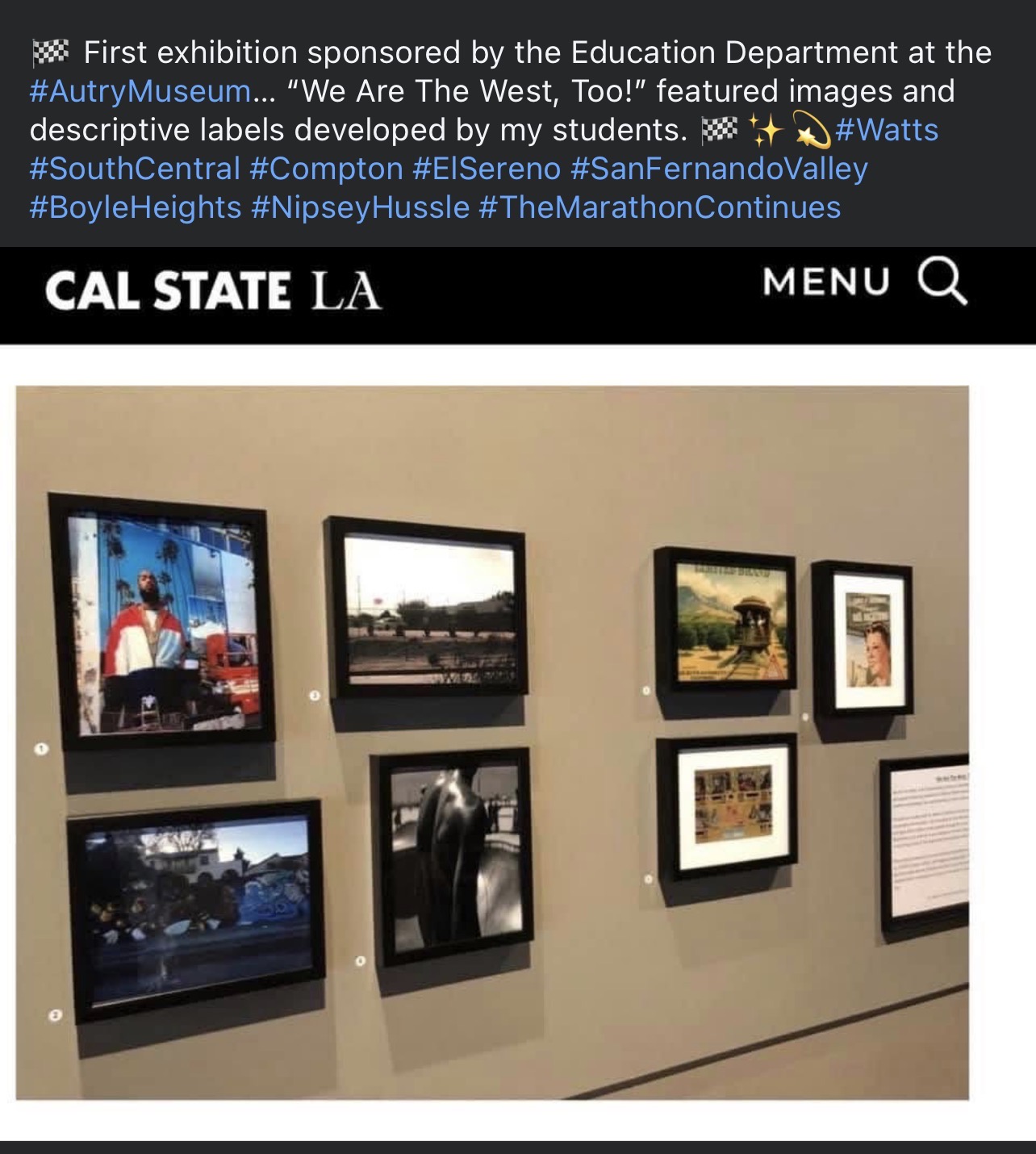
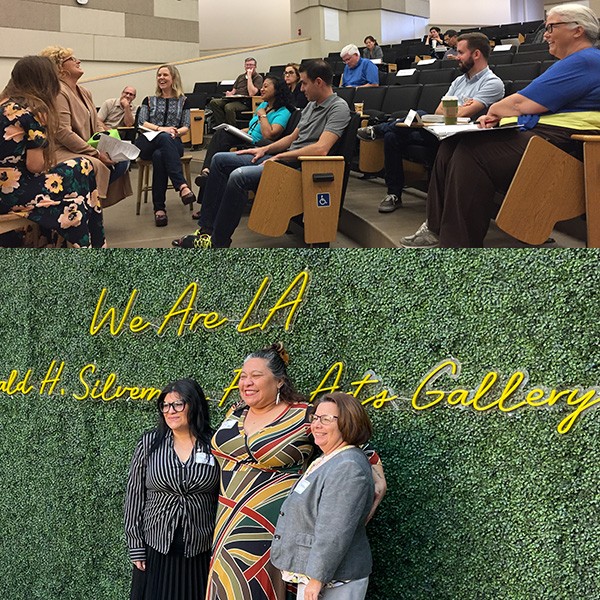
Dr. Dennis's first exhibit at the Autry Museum.
If a colleague wanted to adapt this practice, what would you want them to know, and where should they start?
I would encourage colleagues to start small and start with the learning goal rather than the technology. History Pin is the online platform to develop photography exhibitions, but the platform is not the pedagogy. Ask what you want students to investigate, what evidence they should work with, who their audience will be, and what intellectual decisions they should make. Then scaffold the project through research, source evaluation, interpretation, drafting, feedback, revision, and publication. A colleague could begin with a small History Pin assignment rather than redesigning an entire course. Ask: What are students learning how to do here? Then make one or two of those competencies explicit. For example, a research assignment might develop critical thinking and communication. A collaborative activity might develop teamwork and technology. A community-engaged project might develop leadership, professionalism, and equity and inclusion. The goal is not to force career language onto disciplinary learning. It is to help students recognize the transferable value already embedded within meaningful academic work.
What do you hope sharing this practice adds to conversations about teaching at Cal State LA?
I hope it expands our understanding of career readiness. Cal State LA faculty are already helping students develop extraordinary intellectual and professional competencies across the disciplines. Sometimes we simply have not made those connections visible enough to students, employers, families, or even ourselves. I would like us to think about career-engaged learning not as something added onto the curriculum, but as an opportunity to help students recognize the value of what they are already learning. I also hope we continue connecting career readiness with belonging. Before students can imagine themselves contributing to a profession or community, they often need opportunities to see themselves as capable participants whose knowledge and experiences have value. Our classrooms can become places where that recognition begins.
What do you enjoy doing when you’re not teaching?
When I am not teaching, I enjoy visiting museums and archives, going to the ocean, swimming, listening to music, reading, spending time with my family, and exploring Los Angeles and California history. I am a caretaker for my husband, who is a double amputee, and our son, Cinque, is a college freshman.
I am naturally curious, so even when I am technically not working, I often encounter something that eventually finds its way into my teaching. That connection between my personal interests and teaching has taken on a new dimension this semester through LBS 2340: Multicultural Arts, which I teach through Cal State LA’s Prison Graduation Initiative at the California Institution for Men (CIM). The course brings together many of the things I care deeply about: history, art, culture, identity, community, museums, and the ways people create and communicate meaning. Teaching at CIM has also opened a new learning environment for me and challenged me to continue thinking creatively about where meaningful, culturally responsive education can happen.
I have also been learning the importance of making room for whimsical experiences that do not need to become productive or lead to a particular outcome. Sometimes going to the beach, visiting an exhibit, listening to music, or spending time with family can simply be joyful. I have come to value those experiences as an important part of sustaining my own curiosity and creativity. That sense of curiosity and delight ultimately travels with me wherever I teach, whether I am working with students on the Cal State LA campus, learning alongside museum and archival partners, or teaching Multicultural Arts inside CIM.