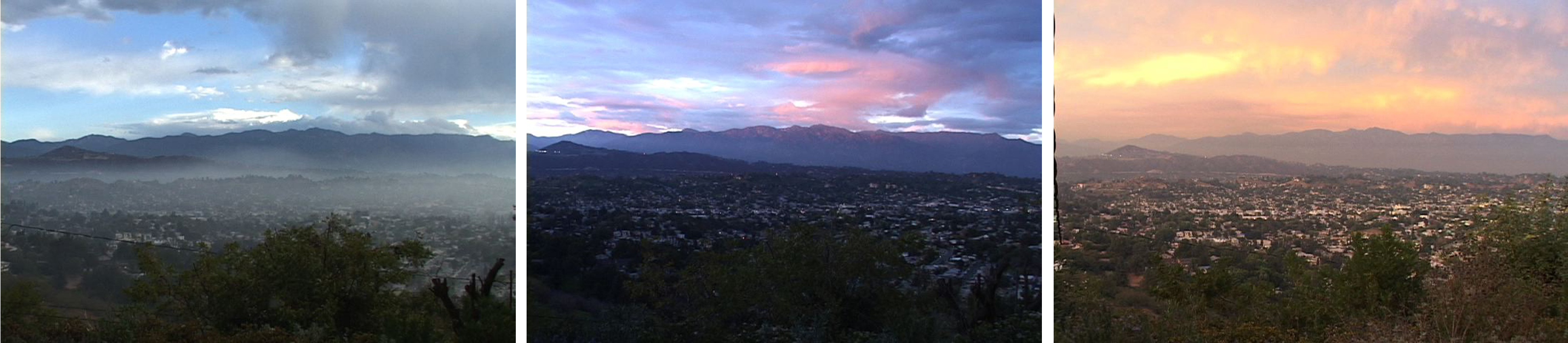
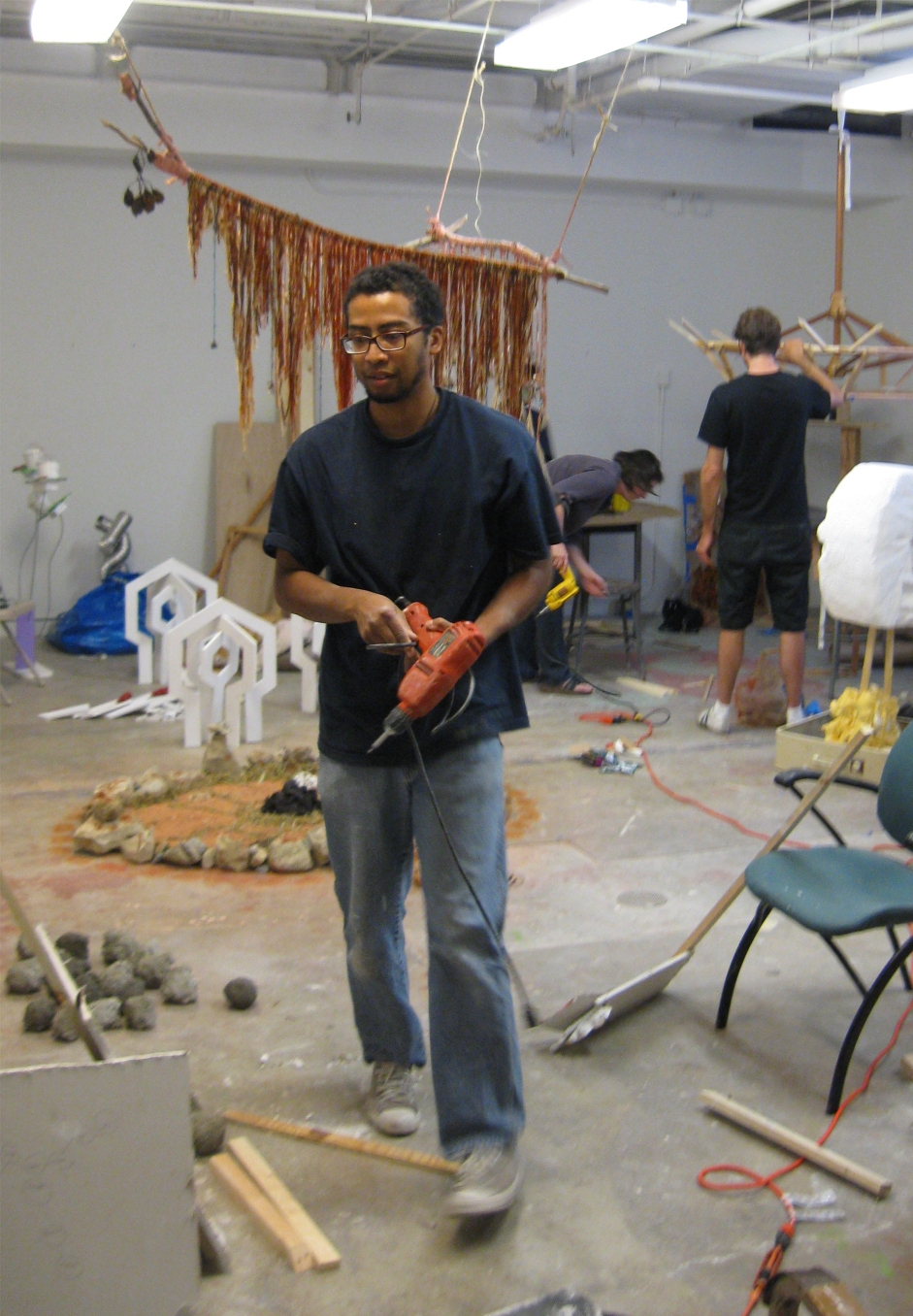
Note to editors and news directors: Select hyperlinked text for an image from Cindy Bernard’s “Year-Long Loop (2-hour version)” and a photo of students setting up the “Short Order” exhibit.
____
IN ‘SHORT ORDER,’ 15 CAL STATE L.A. STUDENTS SHARE GALLERY WITH BERNARD’S ‘YEAR-LONG LOOP’
June 6-27 exhibit showcases array of concepts in variety of media;
Saturday’s reception celebrates culmination, investigation
Los Angeles, CA – An innovator in integrating sound and imagery shares gallery space with 15 California State University, Los Angeles students in “Short Order: Accretions, Arrays, Anomalies,” an exhibition at the University’s Luckman Fine Arts Gallery June 6 through 27. The opening reception will be Saturday, June 6, from 6-9 p.m.
The showing culminates an Art Department spring seminar that brought artist Cindy Bernard to Cal State L.A. to mentor the project’s graduate and senior art students.
Bernard creates photographs and projections that explore the relationship between cinema, memory and landscape. Many of her works also make sound their focus. She has received grants and awards from the J. Paul Getty Trust Fund for the Visual Arts and the John Simon Guggenheim Memorial Foundation; and her work has appeared in museums and galleries in the United States, Canada, Mexico, Europe and Japan.
For “Short Order,” Bernard is premiering “Year-Long Loop (2-hour version),” which combines her interests in landscape and sound. Recorded between October 2004 and September 2005, this “ambient video”—as Bernard describes it—is a cross between John Cage’s “4’33” and Andy Warhol’s “Empire.” Its 24-hour version is an exercise in “extreme structuralism,” she said.
Bernard is the founder and director of The Society for the Activation of Social Space through Art and Sound. Her current work, “Silent Key,” maps communications across vast territorial and political divides. It was recently exhibited at the Boston Center for the Arts.
According to the seminar instructor Richard Wearn, the students used “an investigation of the archive as a point of departure” in creating their projects, with graduate students mentoring undergraduates. (See full listing below.)
“The experience helped build an artistic community,” said Wearn. “It gave the graduate students teaching experience.” Bernard’s participation, he said, fostered discussions about the conceptual interplay of sound, visual projections and other, more traditional media.
The Luckman Fine Arts Gallery is open Monday through Thursday and Saturdays from noon to 5 p.m. Admission is free.
“Short Order” features works of the following Cal State L.A. students (listed with brief statements):
Fiona Cochran works with photographic imagery to lend order and shape to irresolvable, intangible concerns. She attempts to disentangle truth from reality which results in a moral, emotional, and intellectual schematic.
Kat Cutright is interested in how an understanding of nature is socially and intellectually constructed. She draws on collections of organic residue to create sculptures that reframe the concept of landscape.
Lorri Deyer brings ephemeral objects to the attention of the viewer in order to call attention to the elusive nature of the Everyday. Her sculptures foster an awakening and reexamination of our experiences in the world.
Matt Dressler’s work investigates the dynamic between physical and psychological experience. Using constructed environments and situations, he manipulates social interaction with the intent of provoking an emotional response and reevaluating the self.
Bill Faecke uses video to portray his grandfather’s tools, carvings, drawings, watercolors, and other related objects. He translates this footage into an absurdist evocation of the spaghetti western.
Oralia Gomez’s work is inspired by the mystic and spiritual teacher G.L. Gurdjieff, who stated, “We consist of a multiplicity of separate small i’s, not the conscious I, that we all assume we are.”
Charles Hachadourian photographs knocked down light poles as a part of his daily Los Angeles commute. He sees these seemingly insignificant traffic casualties as poetic signs of random yet conspicuously familiar urban landscape.
Karlin Hovasapian explores the visual perception of color and the physiological and emotional reactions it evokes. Her installation expresses notions of nostalgia, curiosity and childhood through the use of color symbolism.
Brittney Lane works with stoneware and mixed media to explore the significance of the archive to modern culture. Currently, she is contemplating the effects of an overload of information on society.
Dalia Monserrat explores the idea of her body as subject and creating an indicative residue of her presence, leaving behind a woman’s mark. Working with her body allows for a more intimate exploration of the self and her femininity.
Poorang Nori draws upon ethno-regional specific reference points from the Mid-East and current cultural cues as a point of departure for his sculptures. He aims to prompt discourse on the dynamics of displaced/placed people’s experience.
Chandra Pok’s work opens a dialogue between history and the present, making explicit the corpulent nature of American imperialism. Her recent work uses apathy toward processed food products as an analogy for the frivolous names given bombing missions in Cambodia during the Vietnam War.
Patrick Quan uses objects extracted from everyday life as material. His work explores the relationship between these objects and contemporary culture.
Greg Schenk appropriates commercial/industrial products and materials, re-organizing them into interactive devices that excite the senses. His work seeks to question the evolution of technology and its role in our lives.
Michael Shields is interested in Los Angeles’ unique infrastructure, the diversity of its synthetic terrain, and the relationship people have with its landscape. He sees Los Angeles as a place that allows for customized experiences, has a very high level of chance, and is as efficient as it is inefficient.
# # #
Working for California since 1947: The 175-acre hilltop campus of California State University, Los Angeles is at the heart of a major metropolitan city, just five miles from Los Angeles’ civic and cultural center. More than 20,000 students and 205,000 alumni—with a wide variety of interests, ages and backgrounds—reflect the city’s dynamic mix of populations. Six colleges offer nationally recognized science, arts, business, criminal justice, engineering, nursing, education and humanities programs, among others, led by an award-winning faculty. Cal State L.A. is home to the critically-acclaimed Luckman Jazz Orchestra and to a unique university center for gifted students as young as 12. Programs that provide exciting enrichment opportunities to students and community include an NEH- and Rockefeller-supported humanities center; a NASA-funded center for space research; and a growing forensic science program, housed in the Hertzberg-Davis Forensic Science Center. www.calstatela.edu